Did you know that as of June 2026, an estimated 5.15 million BTC are lost forever because owners simply lost access to their keys? That represents over 25 percent of the entire Bitcoin supply sitting in digital limbo. It's a sobering reality. It highlights why mastering bitcoin wallet recovery best practices is your most important task as a sovereign holder. Whether you're securing legacy coins, the latest Bitcoin Runes, or your unique Web3 identity, your financial future depends on the protocols you establish today.
We know that self-custody can feel like a high-stakes game. The fear of a single mistake leading to permanent fund loss is enough to make anyone hesitate. You deserve to feel empowered by your digital wealth, not intimidated by it. This guide gives you a professional, step-oriented roadmap to ensure you never lose access to your assets. We'll demystify BIP39 standards and show you how to build a backup strategy that survives hardware failure or lost devices. Let's turn your recovery plan into a bulletproof security architecture that keeps your Bitcoin and .btcme domains accessible for a lifetime.
Key Takeaways
- Shift your perspective from physical devices to the private keys that actually hold your wealth. Your seed phrase is the universal master key for your entire digital existence.
- Implement bitcoin wallet recovery best practices by mastering the BIP39 standard. This ensures your assets remain accessible across different hardware and software platforms.
- Follow a disciplined recovery protocol that prioritizes physical seed accessibility before engaging with new, manufacturer-direct hardware.
- Learn how to use Ordinal-aware wallets to successfully restore modern assets like Bitcoin Runes and BTCME.com domains.
- Leverage professional resources like the BTCME.com blockchain wiki to stay ahead of evolving security standards and verified navigation tools.
Table of Contents
The Seed-First Philosophy: Why Recovery is Pre-Planned
Shift your perspective on what a wallet actually is. It's not the app on your phone or the sleek device in your drawer. If your hardware fails, your Bitcoin isn't gone. You've simply lost the interface. True bitcoin wallet recovery best practices start with understanding that your wealth lives on the blockchain, secured by digital signatures. Your wallet is just a set of private keys. These keys are the only proof of ownership for your BTC, Runes, and Web3 identifiers.
Embrace a "disposable hardware" mindset. This strategy eliminates the anxiety of physical loss. When you prioritize the seed over the device, a broken screen or a lost phone is just a minor setup task. You simply restore your keys into a fresh environment and resume your financial journey. This approach is the cornerstone of true sovereignty. It guarantees your digital future remains accessible regardless of physical accidents.
What is a Non-Custodial Bitcoin Wallet?
Non-custodial means you hold the keys. Unlike custodial platforms where a third party manages your assets, a non-custodial cryptocurrency wallet gives you total authority. If an exchange shuts down, their users lose everything. If you have your keys, you remain in control. These wallets use open standards, allowing you to move assets between different platforms without permission. In 2026, tools from BTCME.com empower you to be your own bank. This is the only way to ensure recovery without depending on a corporation.
The Role of the Recovery Phrase
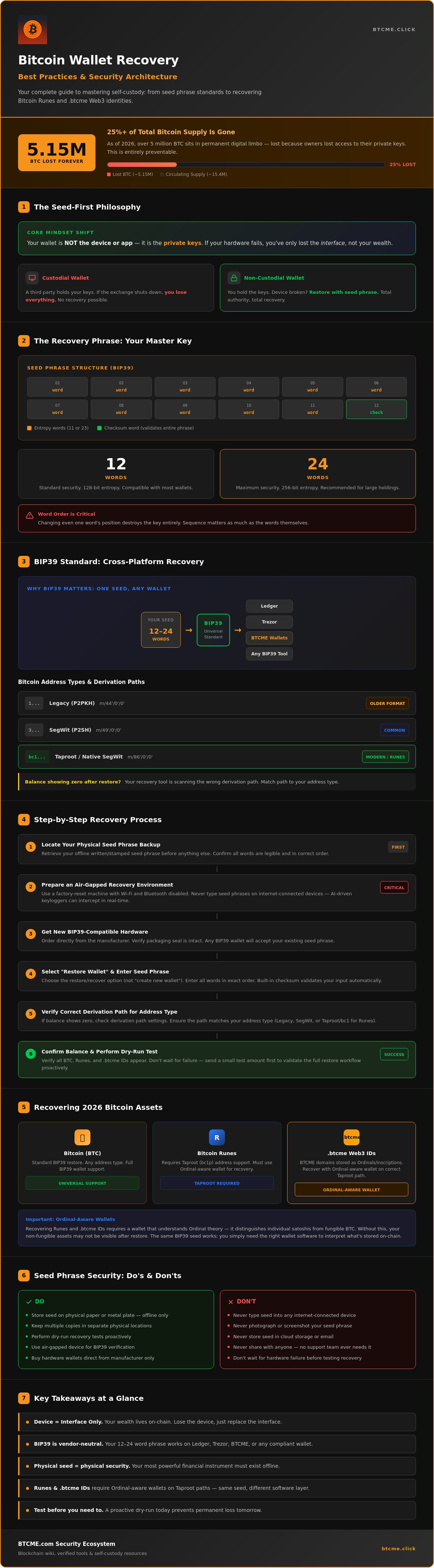
Your recovery phrase is a 12 to 24-word master key. It's a human-readable representation of your private key. These words generate every address and asset tied to your identity. The order of the words is just as vital as the words themselves. If you change the sequence, the key fails. By following bitcoin wallet recovery best practices, you'll store this phrase offline in a secure, physical format. This simple list of words is the most powerful financial instrument you'll ever possess.
Core Recovery Protocols: BIP39 and Security Standards
BIP39 is the technical standard that makes modern self-custody possible. It ensures that your 12 or 24-word recovery phrase is compatible across different wallet brands and software. Whether you're using a Ledger, Trezor, or a wallet from BTCME.com, the underlying mathematical protocol remains the same. This cross-platform compatibility is a pillar of bitcoin wallet recovery best practices. It means you aren't locked into one vendor's ecosystem. If a specific hardware company stops supporting their product, you simply take your words to a different BIP39-compliant device and restore your wealth instantly.
A common point of confusion during recovery is the derivation path. When you import your seed into a new device, your balance might appear as zero. This usually happens because the software is looking at the wrong address type. Legacy addresses (starting with 1) use different paths than modern SegWit (3) or Taproot (bc1) addresses. Understanding these paths is vital for a smooth restoration. You don't need to be a developer to navigate this; you just need to ensure your recovery tool is configured to scan the specific paths where your Bitcoin, Runes, and .btcme domains are stored.
Security during the recovery process is paramount. You should never type your seed phrase into any device that has ever been connected to the internet. AI-driven malware and keyloggers can intercept your words in real-time. Use crypto wallet security best practices to maintain an air-gapped environment. Most recovery phrases also include a built-in checksum. This is a mathematical safety net that validates your word list. If you make a typo, the wallet will reject the phrase immediately, preventing you from ever committing to a faulty backup.
Using Secure BIP39 Tools
Verification is a proactive step in your security roadmap. You can use secure BIP39 tools to convert or verify your seed words in a controlled, offline setting. Always use a "clean" machine for this task. A computer that has been factory reset and has no active Wi-Fi or Bluetooth connections is the gold standard. This protocol ensures that no digital shadow of your master key is left behind on a vulnerable operating system. It's a professional way to confirm that your physical backup perfectly matches your digital keys.
Seed Phrase Verification Best Practices
Don't wait for a hardware failure to test your recovery plan. Perform a "dry run" by sending a small amount of BTC to your wallet, wiping the device, and restoring it from your phrase. This builds the confidence necessary to manage larger sums. Regularly inspect your physical backups. Steel plates are far superior to paper because they survive extreme heat, floods, and structural decay. Never store your seed in a cloud-based note or a digital photo. If it exists on a server, it's a target. Stick to physical, offline storage to ensure your bitcoin wallet recovery best practices actually protect your future.
Step-by-Step Recovery: From Lost Hardware to New Device
Losing your hardware wallet or having your phone stolen can trigger a moment of pure panic. Take a breath. Your Bitcoin isn't in that device; it's on the blockchain. Following bitcoin wallet recovery best practices starts with a calm initial assessment. Before you download any software or buy new gear, confirm your seed phrase is physically in your hands. If you don't have those 12 or 24 words, the most expensive hardware in the world won't help you. Once you've secured your recovery sheet, you're ready to rebuild your access.
When buying a replacement, only source hardware directly from the manufacturer. Avoid third-party resellers or "discounted" units on auction sites. A tampered device is a pre-installed trap. Similarly, ensure your recovery software is the official version. Scammers create "drainer" clones that look identical to popular wallets but exist only to steal your seed the moment you type it in. Always verify the URL and developer signatures before proceeding. This vigilance is your first line of defense during the restoration process.
Restoring to a New Hardware Wallet
Unbox your new device and inspect the packaging for any signs of tampering. Once you're confident it's clean, power it on. Select the "Restore from Recovery Phrase" option during the initial setup. This is where you'll enter your words. Use the physical buttons on the device itself. Never type your seed into a computer keyboard, even if the companion app asks you to. This keeps your keys air-gapped and safe from digital surveillance. Entering the words carefully ensures the internal checksum validates your backup correctly.
Software Wallet Migration
If you're moving from a lost mobile wallet to a desktop interface, compatibility is your priority. Ensure the new software supports the same address types as your old one, such as SegWit or Taproot. After entering your seed, wait for the blockchain scan to complete. This might take a few minutes as the wallet looks for your transaction history. If the balance shows zero and your history is empty, you likely have a derivation path mismatch. Adjust the settings to match your original wallet's path until your assets appear. This methodical approach is a cornerstone of bitcoin wallet recovery best practices, ensuring your digital future is restored without a hitch.
Recovering 2026 Assets: Runes, NFTs, and .btcme IDs
The Bitcoin network has evolved into a vibrant ecosystem of digital artifacts and decentralized identities. Recovering your wallet in 2026 involves more than just seeing a BTC balance. You're likely managing a portfolio of Runes, Ordinals, and unique Web3 domains. Just because your seed phrase restores your private keys doesn't mean these modern assets will automatically appear in your new interface. Understanding how these layers interact is a critical part of bitcoin wallet recovery best practices. Your wealth is now multi-dimensional. Your recovery strategy must be too.
Most standard wallets only look for spendable Bitcoin. They might ignore the specific UTXOs that contain your valuable inscriptions. To see your full digital footprint, you must use an Ordinal-aware wallet during the restoration process. These specialized tools scan the blockchain for specific metadata tied to your Taproot addresses. Without this awareness, your rare assets remain invisible. They aren't lost, but they're inaccessible until you use the right lens to view the ledger. Following bitcoin wallet recovery best practices ensures you don't overlook these high-value digital layers.
Recovering Bitcoin Runes and Ordinals
Many users feel a surge of panic when their Runes don't show up after a seed import. Don't worry. Often, these assets are simply hidden by default to keep the interface clean. Look for a "toggle visibility" or "scan for inscriptions" setting in your wallet's advanced menu. Be extremely careful when making transactions immediately after a recovery. If your wallet isn't properly configured, it might treat an NFT as "dust" and spend it to cover a transaction fee. Use verified block explorers to scan your recovered addresses manually. This ensures every piece of digital art and every Rune is accounted for before you hit send.
Securing Your .btcme Web3 Identity
Your Web3 identity is your digital calling card. When you're registering a .btcme domain, you're linking your human-readable handle directly to your Taproot keys. This makes the recovery process much more intuitive. Instead of staring at a string of random characters, you can verify your restoration by checking if your specific domain is active. Ensure your decentralized naming system (DNS) records are intact after you migrate to a new device. A human-readable ID provides a quick, visual confirmation that you've restored the correct wallet. It adds a layer of confidence to your security protocol that a raw address simply cannot provide.
Ready to claim your spot in the Bitcoin evolution? Get your .btcme namespace Bitcoin Domain today and secure your identity forever.
The BTCME.com Security Ecosystem: Your Partner in Self-Custody
Self-custody is a dynamic journey that requires more than just static knowledge. It demands a reliable source of truth as the Bitcoin network evolves. BTCME.com serves as your professional anchor in this rapidly changing landscape. Our blockchain wiki provides deep-dive insights into the latest recovery standards and security protocols. This resource is essential for staying ahead of major network shifts, such as the Bitcoin Core 31.0 update released in March 2026. By leveraging these verified guides, you ensure your bitcoin wallet recovery best practices remain current and effective. We empower you to navigate technical updates with total confidence.
Finding reliable data during a recovery attempt shouldn't be a gamble. Our curated navigation directory connects you to verified block explorers and essential tracking tools. This eliminates the risk of stumbling onto malicious clones or phishing sites when you're most vulnerable. We prioritize a community-focused approach that puts education above centralized control. You get the tools and the training to manage your wealth independently. This partnership ensures you're never navigating the complexities of the blockchain alone. Our goal is to minimize the distance between your assets and your access.
Advanced Tools for the Modern Collector
Managing a diverse portfolio of Runes and digital artifacts requires technical precision. The BTCME.com suite is designed for collectors who demand non-custodial excellence without the complexity. Our platform offers research tools to help you track digital assets across multiple wallet restorations. We simplify the multi-wallet world by using unique .btcme namespace identities as human-readable anchors. This isn't just about basic security; it's about making your digital existence more intuitive and manageable. You gain the ability to verify your recovery status at a glance, ensuring every asset is accounted for in your restored interface.
Building Your 2026 Security Roadmap
A robust security roadmap combines hardware resilience with a verified Web3 identity. Don't let your backup strategy become obsolete through neglect. Commit to a monthly security audit of your recovery protocols to catch potential issues before they turn into emergencies. Test your hardware, verify the legibility of your physical steel backups, and ensure your seed phrase remains in its secure, offline location. Take the ultimate step in securing your digital presence. Register your .btcme identity today and bridge the gap between your private keys and your public Web3 profile. This proactive stance ensures your bitcoin wallet recovery best practices are a living, breathing part of your financial success.
Own Your Digital Destiny
Your digital wealth is too valuable to leave to chance. By embracing bitcoin wallet recovery best practices, you transform a potential crisis into a manageable process. Remember that your hardware is replaceable, but your seed phrase is the absolute foundation of your sovereignty. As we move further into 2026, the complexity of managing Runes and Web3 identities only grows. You need a partner that understands this evolution.
BTCME has been a pioneer in Bitcoin Web3 identities since 2013. We operate as a non-custodial education hub for the global blockchain community; providing the clarity you need to thrive. Whether you're tracking rare digital collectibles or managing complex Taproot addresses, our specialized tools for Bitcoin Runes ensure you never lose sight of your assets. Don't wait for a device failure to test your readiness. Take charge of your legacy right now.
Register your unique .btcme identity and secure your Web3 future today. Let's build a secure, accessible, and prosperous digital future together.
Frequently Asked Questions
Can I recover my Bitcoin wallet if I lose my seed phrase?
No, you cannot recover your funds if you lose your seed phrase and no longer have access to an active wallet device. The seed phrase is the only master key to your private keys on the blockchain. Without it, there's no central authority to reset your password or grant access. Always store your backup in a fireproof, waterproof location to prevent this permanent loss of your digital future.
Is it safe to use a BIP39 tool online for recovery?
Never enter your seed phrase into an online BIP39 tool. Connecting your master key to the internet exposes your wealth to hackers and AI-powered malware instantly. Use a trusted tool in a strictly air-gapped environment instead. This is a core pillar of bitcoin wallet recovery best practices that ensures your assets remain invisible to digital prying eyes and potential thieves.
What happens to my Bitcoin Runes if I restore my wallet to a new device?
Your Bitcoin Runes stay securely on the blockchain associated with your private keys regardless of your device status. When you restore your wallet, you must use software that is specifically Ordinal-aware to view and manage these assets. Standard wallets might only display your BTC balance, hiding your Runes until you import your seed into a compatible, modern interface that recognizes inscriptions.
How do I know if my seed phrase is 12 or 24 words?
You determine the length by checking your original physical backup created during the wallet setup. Most mobile wallets utilize a 12-word format for convenience, while hardware wallets typically use 24 words for maximum security. Both lengths follow the BIP39 standard. Ensure you have every word in the correct sequence, as even one missing word makes the recovery process impossible.
Can someone steal my Bitcoin if they find my recovery phrase?
Yes, anyone who finds your recovery phrase has total and immediate control over your assets. They don't need your PIN or your physical device to take your funds. They simply import the words into their own wallet and sweep the balance. Treat your seed phrase with more care than physical cash. Keep it hidden, offline, and split across secure locations if necessary.
Do I need the original wallet app to recover my funds?
No, you don't need the original app to regain access to your Bitcoin. Thanks to the BIP39 industry standard, your seed phrase is universal across most modern platforms. You can import your words into any compatible hardware or software wallet to restore your balance. This flexibility is a vital part of bitcoin wallet recovery best practices, protecting you if a specific developer disappears.
How do I recover my .btcme domain identity?
You recover your .btcme domain by restoring the Bitcoin wallet that holds the ownership keys for that specific identity. These domains are tied to your Taproot addresses on the blockchain. Once you import your seed phrase into a Web3-compatible wallet, your identity will automatically reappear. This process ensures your human-readable handle remains yours as long as you control your private keys.
What is a derivation path and why does it matter for recovery?
A derivation path is a mathematical "map" that tells your wallet software exactly where to find your addresses on the blockchain. It matters because different wallets use different paths for Legacy, SegWit, or Taproot addresses. If your balance shows zero after a successful seed import, you likely have a path mismatch. Adjusting this setting in your wallet's advanced menu will reveal your hidden assets.