Your bitcoin wallet is no longer just a digital purse. It is your sovereign passport to the entire Bitcoin Web3 ecosystem. With Bitcoin trading at $62,537.44 and new regulations like MiCA now fully active as of July 2026, the stakes for choosing the right storage have never been higher. You want complete control over your assets. You want to avoid the fear of losing access or drowning in technical complexity. We understand that the jump from hot to cold storage feels daunting. Seed phrase management shouldn't feel like a puzzle you can't solve.
This guide promises to turn you into a confident guardian of your digital wealth. You will master the essentials of Bitcoin storage, from basic security to advanced Web3 identity features like .btcme domains. We preview the best hardware and software options available, simplify the setup process, and ensure your interface is both secure and easy to use. Secure your digital future today. Take full command of your financial journey with a setup that empowers your growth and keeps your assets within reach.
Key Takeaways
- Understand why your wallet is a digital keychain rather than a purse and how it manages your access to the blockchain.
- Navigate the trade-offs between internet-connected storage and offline security to protect your growing digital wealth.
- Master the "golden rule" of self-sovereignty and learn why a non-custodial bitcoin wallet is the only way to truly own your assets.
- Identify essential 2026 features like Lightning Network integration and built-in support for Bitcoin Runes and NFTs.
- Transform your storage tool into a Web3 identity by using your wallet and a .btcme domain to navigate the decentralized web.
What is a Bitcoin Wallet? Defining Your Digital Keychain
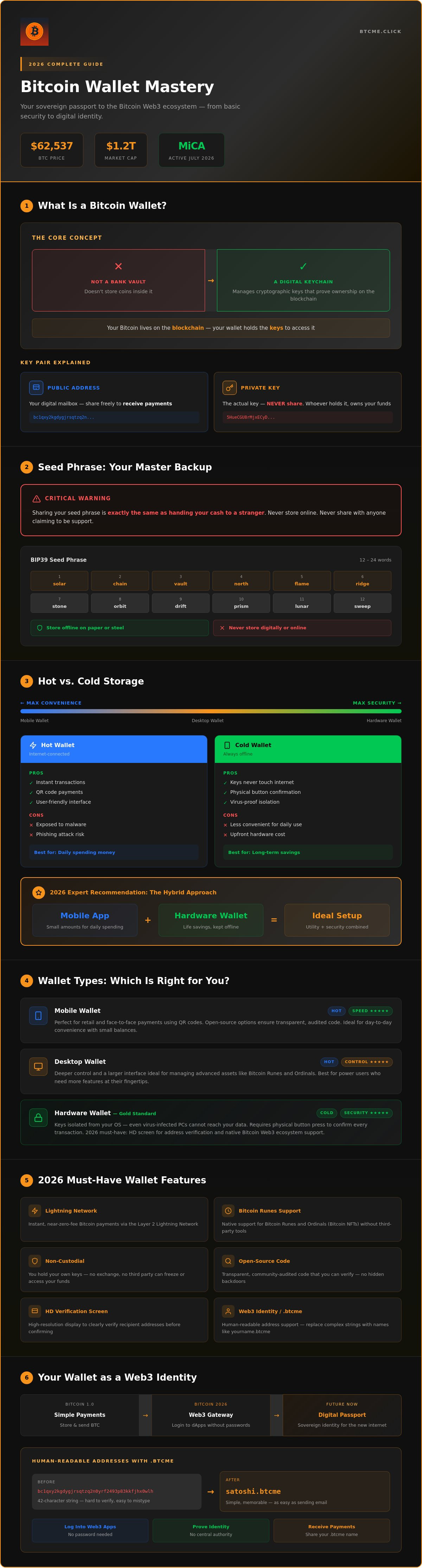
Forget the idea that your bitcoin wallet is a digital bank account. It isn't a vault where you deposit coins. Instead, think of it as a high-tech keychain. Your actual Bitcoin stays on the blockchain, which is a public, distributed ledger. A Cryptocurrency wallet manages the cryptographic keys that prove you own a specific amount of that Bitcoin. Without these keys, you can't move a single satoshi. This distinction is vital for anyone entering the space in 2026.
Understanding the difference between your public address and your private key is your first lesson in financial power. Your public address is like a digital mailbox. You can share it with anyone to receive payments. Your private key, however, is the actual key to that mailbox. If someone gets your private key, they own your funds. This setup creates total transparency for transactions while maintaining absolute security for the owner. It is the foundation of financial sovereignty in an era of increasing global regulation and a market cap that hit $1.2 trillion this year.
The Role of Private Keys and Seed Phrases
Your private key is often represented as a seed phrase for easier management. A seed phrase is a 12 to 24-word master key created by the BIP39 protocol. Treat these words as your ultimate backup. If you lose your phone or your hardware device, these words restore your entire balance on a new device. Never store them online. Never share them with anyone claiming to be support. Sharing your seed phrase is exactly the same as handing over your cash to a stranger on the street. Keep it offline and keep it safe.
Why Your Wallet is Your 2026 Digital Identity
The modern Bitcoin ecosystem has evolved far beyond simple payments. Your bitcoin wallet is now your gateway to the decentralized web. It acts as a log-in button for Web3 applications. This allows you to prove your identity without relying on a central authority or a tech giant. We are seeing a massive shift toward human-readable addresses. Instead of long, confusing strings of characters, you can now use namespaces like .btcme. This turns your complex wallet address into a personalized Bitcoin ID. It simplifies the user experience. Sending assets now feels as easy as sending an email. Your wallet is no longer just about storage; it is your digital signature for the new internet.
Hot vs. Cold Storage: Finding Your Security Balance
Speed or safety? You don't have to choose just one. A hot bitcoin wallet lives on your phone or computer and stays connected to the internet. This makes it incredibly fast for daily transactions. You can pay for services or send funds in seconds. However, that constant connection is a risk. It acts as a potential target for malware and phishing attacks. Use hot storage for small amounts of "walking around" money only.
Cold storage is your financial fortress. These devices stay offline, meaning your private keys never touch the internet. This isolation makes them the gold standard for protecting your long-term savings. According to Forbes in their overview of What Is A Bitcoin Wallet?, the security model you choose should match your risk tolerance. For most users in 2026, a hybrid approach is the smartest move. Keep your spending money in a mobile app and your life savings in a disconnected hardware device. This balance gives you both utility and absolute peace of mind.
Software Wallets: Mobile and Desktop Options
Mobile wallets excel at speed and convenience. They use QR codes for instant face-to-face payments, making them perfect for retail use. Desktop wallets provide a deeper level of control and a larger interface. They are ideal for managing advanced assets like Bitcoin Runes or Ordinals. Always prioritize open-source software. This ensures the code is transparent and audited by the global community. You deserve a platform that is built on transparency and trust. If you're ready to start, explore our secure wallet tools to find your perfect fit.
Hardware Wallets: The Ultimate Fortress
Hardware wallets are the ultimate defense for your digital wealth. They keep your private keys isolated from your computer's operating system. This is crucial because even a virus-infected PC cannot reach your data. You must physically verify every transaction by pressing a button on the device itself. This "human-in-the-loop" security prevents remote hackers from draining your funds without your physical consent. In 2026, don't settle for basic hardware. Demand a bitcoin wallet with a high-resolution screen for clear address verification and native support for the wider Bitcoin Web3 ecosystem. Build your foundation on hardware that is as resilient as the blockchain itself.
Custodial vs. Non-Custodial: Why Self-Sovereignty Wins
Ownership in the digital age is binary. You either own your assets, or someone else holds them for you. The golden rule of the industry remains: Not your keys, not your coins. If you use a custodial service, you are essentially asking permission to access your own money. A non-custodial bitcoin wallet removes that middleman entirely. It gives you full control, absolute privacy, and total resistance to censorship. No bank can flag your legal transactions. No exchange can freeze your account during a market surge.
Many beginners hesitate because they fear losing access. They ask, "What if I lose my password?" In the world of self-custody, your seed phrase is your ultimate safety net. Unlike a traditional bank password, you don't need a corporate office to reset it. You are the master of your own recovery. This level of responsibility is the price of true freedom. For those looking for Easy Bitcoin Wallets For Beginners, the transition to self-hosting is the most critical step you will take in your financial journey.
The "Exchange Trap" and How to Avoid It
Leaving your assets on an exchange is a gamble. You're holding a promise of payment, not the actual asset. History is littered with platforms that failed, leaving users with nothing but empty promises. Don't fall into the trap of convenience. Moving your first purchase to a private bitcoin wallet immediately is the only way to secure your digital future. Withdraw your funds as soon as the transaction clears. Ownership starts the very second you hold the keys. It's a simple habit that protects your wealth from platform risks and corporate insolvency.
Non-Custodial Freedom: The Power of Self-Hosting
True participation in the Bitcoin Web3 economy requires self-sovereignty. You cannot fully experience the growth of Bitcoin Runes or NFTs through a restricted exchange interface. Self-custody allows you to interact directly with the blockchain. It's the only way to manage your digital identity and secure your unique .btcme domain. This isn't just about security; it's about unlocking the full potential of your assets. Learn more about non-custodial security here and start building your sovereign future today. Take the lead in this modern opportunity and join a community of independent, tech-savvy holders who value transparency and control.
Key Features to Demand in a 2026 Bitcoin Wallet
Choosing a bitcoin wallet in 2026 requires looking beyond simple storage. The ecosystem has moved toward a multi-layered reality. You need a tool that handles more than just standard transactions. Demand a wallet that offers Replace-By-Fee (RBF) and deep fee customization. With the average Bitcoin transaction fee sitting at $0.316 as of July 3, 2026, you must have the power to prioritize your transfers. If the network gets congested, RBF allows you to increase your fee to ensure your transaction doesn't get stuck in the mempool for days. This puts the control back in your hands.
Your wallet should also act as your digital nameplate. Modern users no longer want to copy and paste long, intimidating strings of characters. Your chosen interface must support Web3 domains. Sending assets to a human-readable address like "name.btcme" reduces errors and builds confidence. This integration turns your financial tool into a recognizable identity across the decentralized web. It makes the entire process feel as natural as sending a text message. It's about making your financial journey as streamlined as possible.
Managing Modern Bitcoin Assets: Runes and NFTs
The rise of digital collectibles has changed the rules of custody. Your wallet must be "Ordinals-aware" to protect your assets. If your software doesn't recognize these unique inscriptions, you might accidentally spend a valuable NFT as a regular transaction fee. Look for a clean, visual UI that tracks your digital packs and collections separately from your main balance. Bitcoin Runes are a unique protocol for issuing fungible tokens directly on the Bitcoin network. Managing these tokens requires a platform that understands the specific technical requirements of the protocol without adding unnecessary complexity to your daily routine.
Speed and Scalability: The Lightning Network
Bitcoin is now a viable global payment layer. The Lightning Network makes this possible by enabling near-instant transactions for a fraction of a cent. It turns Bitcoin into a currency for coffee-sized purchases and micro-tips. When selecting your bitcoin wallet, prioritize those that offer "unified balances." This feature shows your Layer 1 and Layer 2 funds in a single view. You shouldn't have to manage two separate accounts. A seamless experience between the main chain and the Lightning Network is the hallmark of a truly modern facilitator. Ready to upgrade your experience? Get a wallet that supports the future of Bitcoin today.
Beyond Storage: Using Your Wallet for Bitcoin Web3 Identity
Your bitcoin wallet serves as your sovereign log-in button for the decentralized web. In 2026, the utility of your keys has expanded far beyond simple transaction signing. You now use your wallet to authenticate your presence on social platforms, vote in decentralized organizations, and manage your digital footprint without a central authority. This shift marks the end of the era where you were just a user of someone else's platform. Now, you are the owner of your own data and identity. By linking your complex alphanumeric address to a personalized Bitcoin ID, you eliminate the friction that once held back mainstream adoption.
The process of connecting your bitcoin wallet to a human-readable name is the final step in your setup. It bridges the gap between technical security and everyday usability. Instead of verifying 42-character strings, you simply confirm your unique namespace. This transition creates a seamless experience where your financial tools and your digital persona live in one secure place. Position yourself at the center of this modern opportunity. BTCME.com acts as your dedicated hub for this evolution, providing the essential infrastructure to manage your identity and continue your education in the Bitcoin ecosystem.
Registering Your .btcme Namespace
Own your name on the most secure blockchain in history. A .btcme domain turns your wallet address into a recognizable brand. This isn't just about vanity; it is a critical security feature. Using a Web3 ID significantly reduces the risk of "copy-paste" errors during transactions. You no longer have to worry about malware altering a long string of text in your clipboard. You simply type your name and send. Take action now to claim your digital territory before the most desirable names are taken. Secure your identity and build your future on a foundation of clarity and trust.
The BTCME.com Ecosystem: Tools for the 2026 Bitcoiner
Success in the digital age requires the right resources. BTCME.com provides a curated navigation directory and an extensive blockchain wiki to keep you ahead of the curve. These tools ensure you never stop learning as the technology evolves. We also offer secure BIP39 tools for seed phrase verification, allowing you to audit your security without compromising your privacy. Our platform is designed to be your supportive guide, making complex processes feel straightforward and accessible. Start your journey with confidence. Secure your Bitcoin ID and explore Web3 domains at BTCME.com to take full command of your digital life today.
Take Command of Your Digital Sovereignty
You've moved from curiosity to clarity. Choosing your first bitcoin wallet is the single most important step toward financial independence in 2026. You now understand the vital balance between hot and cold storage. You know that self-sovereignty isn't just a buzzword; it's the only way to truly own your assets and participate in the wider Web3 ecosystem. By mastering seed phrase management and demanding features like Lightning Network support, you've built a foundation that is both secure and highly efficient.
Your journey doesn't end with storage. It begins with identity. Transitioning your complex addresses into a human-readable format is how you simplify your digital life. BTCME.com stands as your partner in this evolution, acting as a pioneering educational hub for Runes, NFTs, and advanced security. Don't wait for the future to happen to you. Register your unique .btcme domain and claim your Bitcoin ID today. Take full control of your digital networking and growth. Your sovereign future is ready for you.
Frequently Asked Questions
How do I get a Bitcoin wallet for the first time?
Download a reputable software app or purchase a hardware device to begin. Initialize the setup by generating a new seed phrase. Write these words down on paper and store them in a secure, offline location. This process creates your private keys and provides a public address to receive funds. It is a quick setup that puts you in total control of your assets immediately.
Is a Bitcoin wallet free to use?
Most software-based bitcoin wallet options are completely free to download and install. You only pay network transaction fees when you send Bitcoin to another address. Hardware wallets require an upfront purchase for the physical security device. Avoid custodial wallets that claim to be free but charge hidden spreads or restrict your ability to move your own funds freely.
What happens if I lose my phone with my Bitcoin wallet on it?
Restore your funds immediately by entering your backup seed phrase into a new device. Your Bitcoin isn't actually stored on the phone; it lives on the blockchain. As long as you have your 12 to 24-word recovery phrase, you can regain access from any compatible wallet software. Without that backup, your funds are gone forever. Always keep your seed phrase safe and offline.
Can someone hack my Bitcoin wallet if they don’t have my seed phrase?
Remote hacking is nearly impossible if your seed phrase remains offline and private. Most security breaches occur when users are tricked into revealing their keys through phishing or malware. A hardware wallet adds an extra layer of protection by requiring a physical button press to confirm transactions. Stay vigilant and never enter your recovery words into any website or share them with anyone.
Do I need a different wallet for Bitcoin Runes and NFTs?
Select a bitcoin wallet specifically designed to recognize Ordinals and Runes to protect your collectibles. Standard wallets might not "see" these unique assets and could accidentally spend them as regular transaction fees. Modern interfaces in 2026 typically include built-in support for these tokens. This allows you to manage your entire digital portfolio, from currency to art, within a single secure application.
What is the difference between a Bitcoin ID and a wallet address?
A Bitcoin ID provides a human-readable name that maps directly to your complex, alphanumeric wallet address. Think of it like a contact name in your phone versus the actual phone number. Using a .btcme domain makes sending assets as simple as typing a name. It reduces the risk of copy-paste errors and turns your technical setup into a professional digital identity for the Web3 era.
How much Bitcoin should I keep in a mobile wallet versus a hardware wallet?
Treat your mobile wallet like a physical wallet and your hardware wallet like a high-security vault. Keep only the small amounts you intend to spend soon on your phone for daily convenience. Store the bulk of your savings on a disconnected hardware device. This hybrid approach ensures you have liquidity for quick payments while keeping your life savings isolated from internet-based threats.
Can I use the same Bitcoin wallet on multiple devices?
Sync your funds across multiple devices by importing your unique seed phrase into different applications. This allows you to check your balance on a desktop and make payments using your mobile phone. While convenient, remember that every device holding your keys is a potential point of entry. Balance your need for accessibility with the necessity of keeping your most sensitive data as private as possible.